Decide which plants need help
A tall plant does not always need a stake. Some stand well on their own, while others lean when flowers or fruit add weight. Look at how the plant grows, not just its expected height. A single upright stem may need one stake; a plant with several spreading stems may be easier to manage inside a cage or between a few supports.
Consider the site, too. A plant in an exposed bed may need support earlier than the same plant in a sheltered spot. Heavy rain can weigh down broad leaves and flower heads, while a crowded planting may stretch toward light and become less sturdy. If a plant repeatedly bends into a path or lies across its neighbors, adding support can keep the bed accessible as well as protect the stems.
The aim is not to hold every stem perfectly still. A little movement is normal. Support should prevent damaging bends and keep heavy growth upright without forcing the plant into an unnaturally narrow shape.
Choose a support that suits the plant’s shape
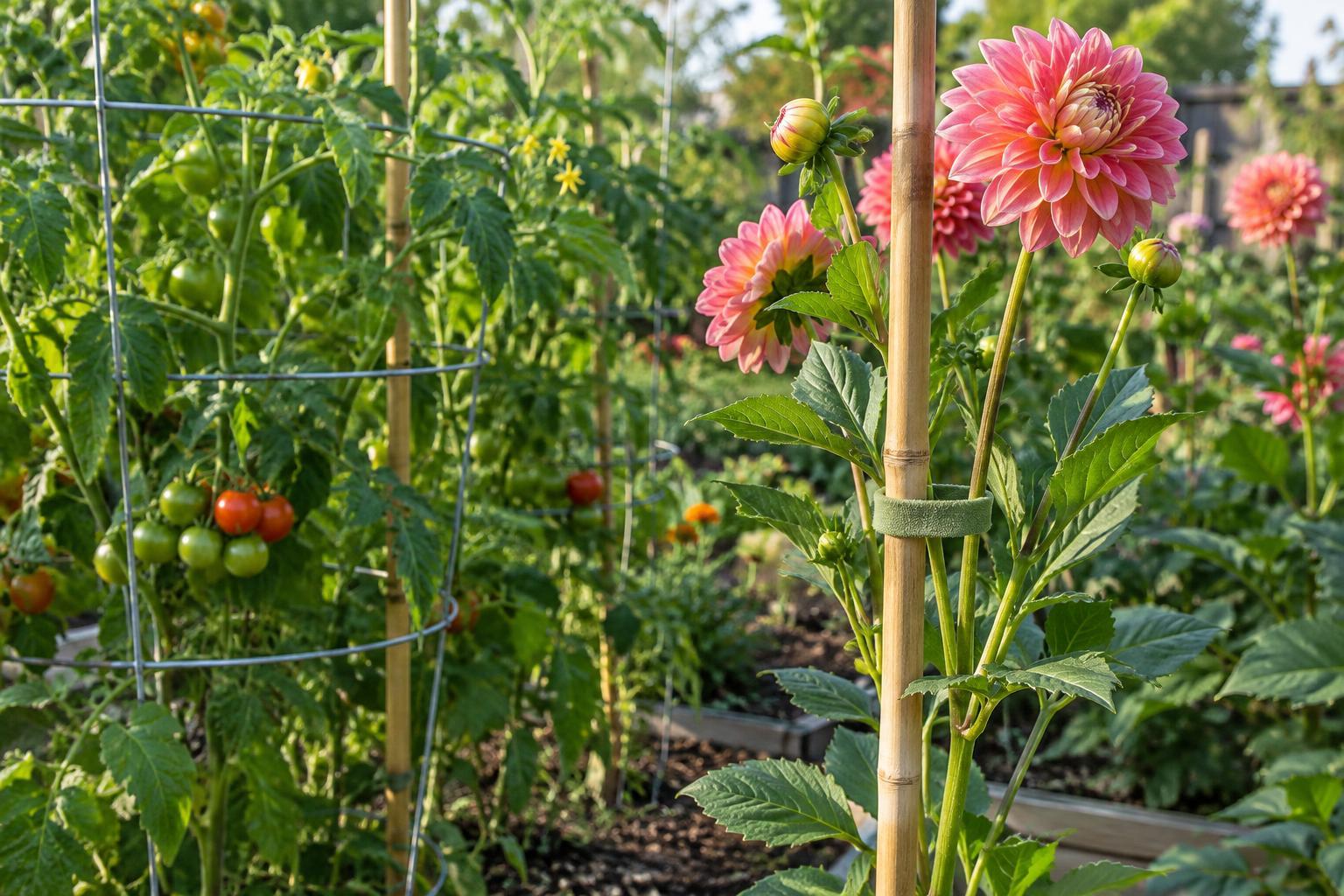
For a plant with one main stem, use a sturdy stake tall enough to reach near the part that needs support after it is set in the soil. For a bushy plant, a cage or several stakes connected with garden twine can hold the outer stems while leaving space in the middle. A branching plant may need a wider support than it appears to need when young, so allow room for its mature spread.
Choose a support that can carry the plant’s likely weight. Thin sticks may be adequate for light annual flowers but may bend under a crop of fruit or a large flower head. Smooth-edged materials are less likely to scrape stems. Check that any cage openings are large enough to reach through for harvesting or routine care.
Matching the support to the growth habit usually works better than adding more ties to a poorly placed stake. If you are unsure, start with a simple, adjustable arrangement that you can widen or reinforce as the plant grows.
Install supports before stems become tangled
Put supports in place while plants are small enough to work around easily. This reduces the chance of snapping branches while trying to fit a cage over mature growth. Position a single stake a short distance from the main stem rather than pressing it against the plant. Push it firmly into the soil so it does not wobble when you add a tie.
If you are adding a support later in the season, work slowly and check where the stems emerge from the soil. Roots may have spread beyond the visible plant, so avoid repeatedly driving stakes into the root area. In a crowded bed, several stakes around the outside may be easier to install than one in the center.
Guide stems into position gradually. A stem that has leaned for weeks may not straighten safely in one move. Support it where it rests comfortably, then adjust only if its growth allows. It is better to accommodate a gentle curve than to break a healthy stem for the sake of a tidy row.
Tie loosely and leave room for growth
Use soft plant ties, strips of flexible fabric, or garden twine that will not cut into a stem. Make a loose loop around the plant and fasten the tie to the support, leaving enough space for the stem to thicken. A figure-eight tie can keep the stem from rubbing directly against a stake: one loop surrounds the stem, the other surrounds the stake, and the tie crosses between them.
Place ties where they steady a vulnerable section without pulling branches together. Several loose ties along a tall stem are often gentler than one tight tie near the top. Avoid tying across developing flowers or fruit, and keep knots where you can find and adjust them. If a stem sways slightly within its support, that is usually preferable to binding it rigidly.
Check supports as the plant changes
Revisit supported plants during regular watering or harvesting. Look for ties that are tightening, stems that have grown beyond the cage, and stakes that have loosened in wet soil. Move or replace a tie before it leaves a mark on the stem. Add a second support if new growth has become heavy, rather than pulling it sharply toward the original one.
At the end of the growing period, remove ties and reusable supports when they are no longer needed. Clean off soil and plant debris, then store supports where they will stay dry enough to be useful next time. Notice which arrangements held up well and which made harvesting awkward; those observations can guide a simpler setup for the next planting.